Lately, the Ministry of Tourism and Antiquities is caring in opening museums in coastal cities as Sharm El Sheikh Museum and Hurghada Museum for more entertainment for tourists and adding cultural value for this city besides the beach tourism.
In Sharm El Sheikh, you can enjoy doing several activities as soak up the sun on the beaches, diving to see its coral reefs, snorkeling, visiting Naama Bay, and exploring Ras Mohammed National Park.
Sharm El-Sheikh
Also, Sharm El Sheikh is a city in the Sinai Peninsula, so you will be able to do safari trips in the Sinai desert and discover St Catherine Monastery and Moses mount.
Saint Catherine’s Monastery
Sharm El Sheikh Museum Sharm El Sheikh Museum is opened in October 2020 to be the first museum to be opened in Sharm El-Sheikh and Sinai.
The concept of displaying in this Museum is reflecting the different aspects of human civilization and culture in the ancient Egyptian and the Greco-Roman civilizations and Muhammad Ali Pasha’s family. The display in the museum is divided into:
The Grand Hall exhibits the history of humans and wildlife in ancient Egypt and highlights the achievements of the ancient Egyptians in science, mathematics, industry, crafts, family life, and mummies and statues for gods in the ancient Egyptian beliefs. Those gods are like Thoth, Sobek, Hathor, and Horus.
The Civilization Hall displays the funeral collection of Isetemheb, the wife of the high-priest of Amun Panedjem II, and the priestess of Isis, Min, and Horus in Akhmim, like the inner and outer coffins, Canopic jars, cosmetics, and perfume vessels.
Then there is a hall displaying types of ships and boats used by the ancient Egyptians in several aspects of life as hunting, trade, and sun boats.
Finally, the hall of the cultural heritage of the Sinai community and Bedouins.
This museum distinguished with its facilities, as it contains theater, traditional crafts shops, and restaurants.
The Citadel of Qaitbay is considered as one of the most important defensive fortresses along the Mediterranean Sea coast. It is located on the eastern side of Pharos Island in Alexandria.
The history of Citadel of Qaitbay This citadel was constructed by Circassian Sultan Al-Ashraf Abou Anasr Saif El-Din Qaitbay El-Jerkasy Al-Zahiry in 1477 to defend the Egyptian northern borders against the Ottoman attacks, as it was used as barracks for the soldiers and armories.
Sultan Qaitbay was a Mamluk and came to Egypt when he was young. Qaitbay became the Sultan in 1468. He was one of the most prominent Mamluk Sultans.
Qaitbay Citadel was established where the place of Lighthouse of Alexandria, one of the Seven Wonders of the Ancient World. Egypt was distinguishes housing two wonders of the Seven Wonders of the Ancient World, the great pyramid of Khufu and the Lighthouse of Alexandria.
This lighthouse was built during the Ptolemaic period and destroyed due to an earthquake that occurred in 1303. Some of the lighthouse stones and blocks were reused in the construction of the citadel.
The Lighthouse of Alexandria
Throughout history, this citadel played a vital role due to its strategic location, so the Sultans and rulers keened to maintain it continuously. The citadel continued to function during the Mameluke period, the Ottoman period, and the Modern period, but in 1882 during Orabi revolt, the citadel was bombed by the British fleet resulting that it became neglected.
The Egyptian Supreme Council of Antiquities in 2005 started to restore it to become a unique tourist destination on the Alexandria coast.
The description of the citadel
The citadel consists of three floors:
The first floor contains the mosque divided into a courtyard and four iwans.
The second floor has several halls and passages, might be used store weapons and provisions.
The third floor houses the Sultan’s hall where he observed from it the movement of ships in the harbor, grain mill, and bakery for preparing food for soldiers.
The Haramlek of Montazah Palace, the last royal palace was built during the Muhammed Ali family, is one of the most famous sightseeing in Alexandria. It is located on at the eastern edge of Alexandria on the Mediterranean Sea coast.
The history of the Montazah Palace The royal family of Muhammad Ali Pasha chose Alexandria to be one of their destinations to escape from the summer heat. The Khedive Abbas Helmy II used to ride horses near Sidi Bisher in Alexandria. He noticed the amazing views of the sea in this place, so he decided to build Montazah Palace and gardens in 1892 to be the summer residence for the royal family.
The Khedive Abbas Helmy II asked Dmitri Fabersious, one of the most famous architects at the time, to put the design of this palace. The design of this palace mixes various types of styles as Byzantine, Classic, Gothic, and Islamic.
The Egyptian revolution that occurred in 1952 led that the palace was taken away by the Egyptian government. Then this palace becomes one of the presidential palaces for hosting the president’s visitors.
The Elements of Montazah Palace This palace, like the ottoman palaces, contains the Haramlek and the Salamlek. The Haramlek and the Salamlek are Turkish words. The Haramlek means the place where women stay, while the Salamlek is the place where men meet.
The Haramlek was built by King Fouad I in 1925 to be the last royal palace founded during the Muhammed Ali family.
The Haramlek consists of three floors:
The first floor contains many rooms, but the most important rooms are the office of the king and the meeting room.
The second floor houses many suites of the king, the queen, the princesses, and the prince Ahmed Fouad.
The third floor hosts a hung terrace overlooking a fabulous view of the Mediterranean Sea.
This palace has a royal elevator.
Montazah Palace
The Montazah Gardens: the palace is surrounded by lush gardens with a Victorian bridge. It is 3000 meters wide and houses a huge selection of rare trees and plants.
The Montazah Gardens
King Farouk Tea Kiosk: this kiosk is located in the gardens of Montazah Palace. It was opened in 2020 to the public for the first time ever, as you will be able to enjoy having your brunch as a king while seeing the sea.
The Egyptian architect Mustafa Pasha Fahmy designed this kiosk and built it in 1936. It is built in the Roman style, as there are four statues depicting women who symbolize the four seasons of the year.
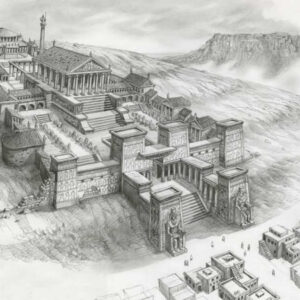
Throughout ancient history, Alexandria was known as a center for learning and melting different cultures because it houses the library of Alexandria or Bibliotheca Alexandrina the most famous destination for students in the ancient world.
It is important to be referred that there are two libraries of Alexandria libraries (the ancient library of Alexandria – the modern library of Alexandria).
The ancient Bibliotheca Alexandrina During the Ptolemaic period, Ptolemy II built the ancient Alexandria Library. This library contained many books in different specialties, so it became the main destination of many science students in the ancient world. It is said that it houses about 700,000 books, as it contained books from the ancient Egyptian and Greek civilizations, as well as, the library obligated its scholars to leave a copy of their writings in the library. This led to making this library very rich with books in several specialties and from different cultures.
Ancient Library of Alexandria
Some of its students were Euclid and Archimedes. This library was divided into three parts the original library or the Muses, the smaller library, and the book store.
It was a public library, in contrast to the libraries of temples at that time, which were accessed only for priests of temples.
Unfortunately, the ancient Library of Alexandria was destroyed during the attack of Julius Caesar and Cleopatra VII against Ptolemy XIII in 48 BC, where the ships in Alexandria port were burned by Caesar and this fire spread to the library.
The modern Bibliotheca Alexandrina The modern Bibliotheca Alexandrina was built on the 16th of October 2002 when Lotfy Dowidar and the Egyptian Government asked UNESCO to revive the ancient Library of Alexandria.
The library is surrounded by a great wall, decorated with the letters and signs of 120 languages, referring to the wealth of knowledge in that building. This wall is made of the granite of Aswan.
the modern library of Alexandria
The Antiquities Museum It is considered the first archeological museum to be situated within a library. The museum collection displays the ancient history of Egypt from the ancient Egyptian civilization to the Roman period. Part of the museum collection is displayed under the water of the Mediterranean Sea. The museum texts are written in three languages (English, Arabic, and French).
The Manuscripts Museum This museum distinguishes with housing the largest collection of digital manuscripts in the whole world. It provides digital access to more than 6,000 rare books, maps, and documents.
The Sadat Museum This museum contains many personal belongings of the Egyptian president Anwar Al Sadat, as his Nobel Prize medal and his military robe stained with blood, which he wore on the day of his assassination.
The History of Science Museum
The Arts and Multimedia Library/li>
The Taha Hussein Library for the visually-impaired This library is named with Taha Hussein Library because its materials are specially designed for blind and visually impaired people. These materials enable them to read books.
The Children’s Library
The Young People’s Library
The Exchange and Archive Section
The Rare Books and Special Collections Library
The Planetarium Science Center
Culturama: It is a patented nine-screen interactive technology created by the Egyptian Center for Documentation of Cultural and Natural Heritage (CULTNAT) in 2007. Culturama allows the library to inform information that could never have been displayed by traditional displaying methods. Culturama exhibits three times from Egyptian history (Ancient Egyptian Period – Highlights of Islamic Civilization – Modern Egypt).
The new library of Alexandria seeks to revive the old library approach, as it is dedicated to recapturing the spirit of openness, spreading culture, and acting as a public research center.
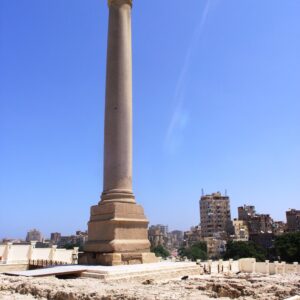
Pompey Pillar is one of the most famous attractions in Alexandria. It is considered the longest column in Egypt, as it is about 27 meters long. It was constructed in 292 AD by the trustee of Alexandria, Postumus.
This pillar or column is divided into 3 parts. The first part is its base that has inscriptions of names of ancient Egyptian Kings, referring to that this stone was reused. The second one is the body of the column taking a circular cylindrical shape and made of red granite from Aswan. Then the crown. Al-Maqrizi wrote about this crown that he heard the Alexandrians said that this crown allowing 22 persons to sit on it and having their food.
Pompey Pillar
Different Names to This Pillar Pompey’s Pillar is a misleading name. It is believed that when the Roman General Pompey fled to Alexandria from Rome, Ptolemy XII murdered him and his head was put on the top of the column, but that is not true and this pillar has nothing to do with Pompey.
Arab called it masts pillar because they thought that it looks like the masts of the ships.
According to an inscription beside the column, the closest to the right name is Diocletian Pillar. This text refers to the trustee of Alexandria, Postumus, who built this pillar in gratitude for the Roman Emperor Diocletian as there was a famine in the city so Diocletian ordered that a portion of the wheat be sent to Rome annually be given to the Alexandrians. As well, he exempted them from paying taxes during these hard times.
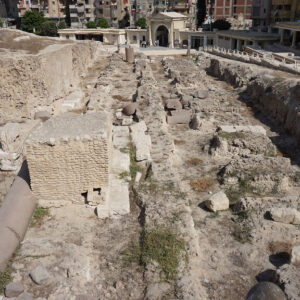
Besides the pillar, there are two sphinxes and an open museum displaying what was discovered in the Serapeum, dedicated to Alexandria’s patron god, Serapis.
The Catacombs of Kom el-Shuqafa are considered the first catacombs in the whole world. It is a complex of impressively decorated tombs dating back to the Roman period. It is located in the district of Karmouz to the east of Alexandria.
The Kom el Shoqafa is its Arabic name, meaning in the English language the mound or hill of potsherds, referring to the broken dishes and plates that was found in this place. Also, the word Catacomb means a rock-cut tomb around a well.
This place is considered an open museum, as, besides tombs, there are several Roman monuments as the fountain and the bathtub.
The Catacombs of Alexandria This Catacomb was discovered by chance in 1900 when a donkey fell in the well. It is one of the most important examples referring to the fusion between ancient Egyptian art and Greco-Roman art.
The Catacomb originally belonged to a wealthy Roman family who started to use it for burial in the middle of the 2nd century AD. Later, the catacomb was expanded to be a public cemetery.
It consists of 3 floors housing rock-cut tombs in the 1st and 2nd levels, but the 3rd is completely underwater. These two levels can be accessed by a central spiral staircase to a depth of 35 meters around a well.
When you descend the catacomb, you can see a circular hall with a vaulted ceiling called the rotunda. This hall contained 5 busts (now these busts are displayed in the Greco-Roman Museum in Alexandria).
After that, you will move to the Triclinium hall, where the visitors of the tomb were taking some rest after descending the stairs of the tomb. This hall supports by 4 pillars and contains 3 benches, taking the shape of the letter U. It is thought that this hall was used by the visitors of the tomb for eating food.
Then there is another hall containing bones for horses. It is called Holy Horses Hall, as it is believed that these horses were used in horse racing.
Finally, there is the main shrine of this catacomb. There are 2 statues, their features combining between the ancient Egyptian and Greco-Roman arts. It is thought that these statues belonging to the original owners of the catacomb.
Catacombs of Kom el Shoqafa
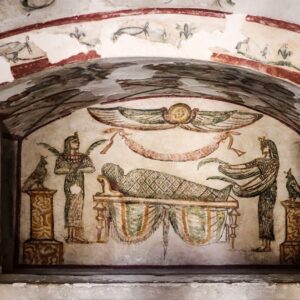
The Tomb of Tigrane The Tomb of Tigrane is situated a few meters away from the main catacombs. It dates back to the 1st century A.D. and was discovered in 1952. It is famous for its wall paintings executed in the Hellenistic style.
The Tomb of Tigrane
You Can enjoy a virtual tour to the Catacombs via the virtual tours of the Ministry of Tourism and Antiquities. The Catacombs of Alexandria
Throughout history, Aswan was famous for its granite quarry that was used by the ancient Egyptians for constructing several buildings during the ancient Egyptian civilization, like the valley temple of king Chephren and two obelisks of Queen Hatshepsut in Karnak Complex. This quarry of granite houses a unique monument that is the unfinished obelisk of Queen Hatshepsut, dating back to the 18th dynasty, New Kingdom. It is one of the most important tourist attractions in Aswan.
The Importance of the Unfinished Obelisk This obelisk was made from the red granite of the Aswan quarry. It is 42 meters high to be the longest in Egypt and nearly 1100 tons. The researchers believe that this obelisk was carved to be placed in Karnak Complex.
This obelisk was abandoned and not completed because of appearing cracks in its body during the cutting, as the scratches of the workers’ tools can still be seen clearly on the obelisk body and ochre-colored lines marking where they were working.
This obelisk is considered as a witness to the accuracy and ability of the ancient Egyptians in dealing with giant granite stones and how they cut and established their obelisks, as the bottom side of the obelisk is still attached to the bedrock.
As, they made very small holes directly out of bedrock all along the line of desired detachment. After that, they put the wooden pegs in these holes, then submerged them with water to expand, causing detaching the body of the obelisk.
Why did the ancient Egyptians use to build obelisks? Obelisks are tall and slender monuments. It has four straight sides, taking the pyramidal shape at the top. These four sides are full of inscriptions.
Obelisks had a great role during the 5th dynasty, old kingdom, as it was put inside the temples of Ra, so it was known as a sacred symbol of the cult of the sun. Also, they are a symbol of the Pn-pn that is referring to the primeval hill where the creation of the world began.
Despite the difficult times, the world is witnessing amid the COVID-19 pandemic, the Ministry of Tourism and Antiquities in Egypt is continuing its achievements, as it transferred the royal mummies in a majestic parade and opened the National Museum of Egyptian Civilization. Also, it is preparing to open the great avenue of sphinxes and the Grand Egyptian Museum and transferring the whole collection of King Tut from the Egyptian Museum in Tahrir Square to the GEM. Among these great projects is transferring the Khufu ship or the solar boat to the Grand Egyptian Museum.
The History of this Boat On 26 May 1954, Kamal El Malakh discovered this boat in a hole covered with almost 40 limestone blocks in the south of the pyramid of Khufu. He found it preserved and disassembled for 1224 individual pieces. Besides this boat, he found oars and ropes. Now, this boat is displayed in the Solar Boat Museum built where this boat was discovered.
Solar Boat
What does this boat look like? The boat was made from cedar which was imported from Lebanon. It is about 44 meters long and 6 meters wide. The bow of this boat takes the shape of a bundle of papyrus. This bow is about 6 meters high, while its stern is 7 meters high.
This boat contains a main cabin divided into two parts. This cabin is surrounded by 36 columns. The boat has 10 oars, 5 on each side. These oars take the shape of a spear, referring to the tool used by the god Horus to kill the god Set.
The cabin of Solar Boat
The oars of Solar Boat
In the manufacture of that boat, the ancient Egyptians did not use metal nails but relied on interlocking and tying with ropes.
The ropes of Solar Boat
Why this boat was called the Solar Boat? In the past, some researchers thought that this boat was the boat used by the king in the other world for sailing during his day and night trips with the god Ra (Sun God), so they called it a solar boat.
But Ahmed Youssef, the restorer of this boat, proved that this boat had been used before, which showed that it was the boat responsible for transferring the king’s corpse from the east bank to the west.
As well, we know the shape of solar boats from several depictions in tombs, and this boat does not have the same shape despite the completion of its parts.
The transferring to the Grand Egyptian Museum The Ministry of Tourism and Antiquities announced that the King Khufu Ship will be transferred from its current location in the Solar Boat Museum in Giza Plateau, where the ship was discovered, to a new location in the Grand Egyptian Museum (GEM) for its permanent display in June 2021.
Solar Boat Museum was not equipped to house the biggest, oldest, and most valuable organic monument, which began to decay, so the transportation of the boat to a new venue was imperative. In addition, this museum will be demolished as a part of the development of Giza Plateau, as this building cause visually distorts Giza Plateau, lacks the new methods of display, and is not qualified to be accessed to special needs.
Solar Boat Museum
Atef Moftah, the general supervisor of the GEM and the surrounding area, examined with the First Khufu Transport Committee how to safely move the ship from Giza Plateau to the Grand Egyptian Museum.
After several studies, the committee decided to transfer the boat as one piece, like the transfer of King Ramses II colossus, as the boat was packed with special scientific foams and put inside an iron cage to protect it during the transfer. This transfer can be considered one of the most challenging engineering and archaeological projects, as they must preserve the most valuable organic monument in the world.
The halls of the Grand Egyptian Museum will house the first and second ships of King Khufu in a special hall called Khufu Boats Museum Hall. The restoration team is working on conserving the second ship, as the team succeeded in extracting approximately 1272 pieces of wood from the second ship.
The construction of the Aswan high dam was a great dream for President Gamal Abdel Nasser to ensure developing Egypt for all Egyptians. The high dam is fed by the River Nile from south.
The History of Aswan High Dam There are two dams in Aswan, Aswan Low Dam and Aswan High Dam. Aswan Low Dam was constructed in 1898 and completed in 1902. But it was not adequate to control the annual flooding, leading to President Gamal Abdel Nasser think in constructing a higher dam in 1952. The construction for the project began in 1960 after getting funding and was completed in 1968. It was officially inaugurated in 1971.
There is a huge reservoir behind the dam, called Lake Nasser. It was finished filling in 1979. This reservoir is with a reservoir capacity of 132km³.
Nasser Lake
The construction of this dam is considered an impressive engineering feat, as it is 360 feet tall and 12,500 feet across.
The Benefits of the Dam Although the construction of the dam led to a rise in the level of the Nile River, which led to immersion of many monuments and archeological sites as Philae Temple.
Despite this, the dam provides several benefits to Egypt, as
It provides water for around 33,600km² of irrigation land and contributes to increasing the cultivable land in Egypt.
It controls flooding that was threatening the lives of citizens.
It generates power, as it was responsible for producing around 50 % of the electricity production in Egypt and providing many villages with electricity for the first time.
Philae Temple of Isis is the most prominent monument of Philae Island. Philae Island was a rocky island in the middle of the River Nile, located in Aswan.
Philae Island had a great prominence as the center for worshipping the goddess Isis, the mother of the god Horus. This island contains other monuments such as the Kiosk of Trajan, Osiris Chapel, Horus Temple, Hathor Temple, The Gateway of Tiberius, Diocletian, and Augustus Temple.
After the construction of the Aswan Dam, the monuments of Philae Island were submerged underwater for the greater part of the year, and Philae temples were accessible only between August and December. The construction of the High Dam in 1960 threatened to engulf them for good, which resulting transferring the monuments of Philae Island to Agilkia Island in the 1960s during the UNESCO Nubia Campaign, as the temple was dismantled and transferred, stone by stone, from the submerged Philea Island to Agilkia Island. This project took over 9 years to be accomplished.
Philae flooded by Aswan Dam in 1906 Kiosk of Emperor Trajan
Philae Temple is one of the last ancient Egyptian temples to remain active, as it continued to function until the reign of the Byzantine Emperor Justinian I. On that date, the priest of Isis, Esmet-Akhom, carved the last dated hieroglyphic inscription, dating to the late 4th century AD.
The design of Philae Temple of IsisThe Temple of Isis is the most famous temple on Philae Island. It was founded in Ptolemy II’s period, then other Ptolemaic Kings contributed by adding more parts to it. This temple is built on the same style of the New Kingdom temples, with adding some other elements that appeared in the Greco-Roman period like the mamisi and the Nilometer. This temple was used during the Coptic period to be a Christian church.
It is thought that the oldest remains of Philae Temple date back to King Taharqa of the 25th Dynasty, who constructed the first shrine for the Goddess Isis.
The plan of this temple is very simple. It consists of the 1st Pylon leading to an open court, the 2nd pylon, and the Holy of Holies.
Pass through the 1st pylon to reach the main court of the temple. While you go through the gate, you will find the French inscription (“a 7 de la République”) on the right. It refers to commemorate Napoleon’s campaign and the pursuit of the Mamelukes by General Desaix in 1799.
On the right of the main court, there are rooms for Isis priests.
The Mamisi or the House of the divine birth of Horus: You can enter the mamisi from the left side of the court or by the direct gate in the western tower of the 1st pylon. It is a symbol of the birth of Horus. There is a scene in this room depicting Isis suckling her son Horus in the marshes and scenes of the birth of the God Horus.
Then 2nd Pylon leading to inner temple area with 10 columns.
Then 3 shrines leading to a sanctuary or the Holy of Holies.
Philae Temple distinguishes with its Sound and Light Show presenting a narrated storytelling the legend of God Osiris and his wife Goddess Isis and the history of Philae Temple and how it was saved by transferring its rocks to the current place.
an Experience, Memories, Adventure Egypt Where your Dreams Come True, it’s Time to Discover Egypt with our Team, City Tours, Camping, Egyptian Nights, Sailing and More