The Mosque of Amr Ibn Al As

The Mosque of Amr Ibn Al-As is the first mosque established in Egypt and Africa. It is located close to the old Cairo in Fustat city.

Amr Ibn Al-As Amr Ibn Al-As was one of the companions of the Prophet Muhammad (peace be upon him). Caliph Umar Ibn Al-Khattab commanded him to enter Egypt in 641 AD / 20 AH. After he conquered Egypt and abolished Roman rule, Egypt became an Islamic district belonging to the caliphate in Medina.

Then, Amr Ibn Al-As established the first Islamic capital in Egypt and Africa, Fustat. In addition, a mosque holding his name (Amr Ibn Al-As Mosque).

The history of Fustat city: The researchers said that after the Arab conquest of Egypt, Amr Ibn Al-As ordered the Islamic army to set their tents north of Babylon Fort, but when Amr Ibn Al-As came to remove his tent to go ahead to Alexandria for pursuing the Romans, he found that there was a dove built its nest upon it. He refused to remove it and left his tent in that place.

After he won in Alexandria, Caliph Umar Ibn Al-Khattab refused Alexandria as the capital of Egypt and ordered Amr Ibn Al-As to establish a new capital to be the first Islamic capital in Egypt and Africa. So he returned to his tent, where the Nile River and Babylon were fortified because it was a unique strategic location already fortified. He called this new capital Fustat, meaning leader’s tent in Arabic.

Today, Fustat is a part of the Old Cairo District, housing many archaeological sites such as the Ben Ezra Synagogue, the hanging church, and the Cave church, to name a few.

Amr Ibn Al-As Mosque: Amr Ibn Al-As Mosque, also known as the Old Mosque, is called in the Arabic language (al-‘Ateeq).

Some of the companions of the Prophet Muhammad (peace be upon him) assisted in the foundation of this mosque, such as Al-Zubayr Ibn Al-‘Awam and Ubada Ibn Al-Samit. This mosque was built after a year of Arab conquest of Egypt, meaning in 21 AH.

Initially, the mosque was built with mud bricks, and palm tree trunks supported its roof. Addings continued in the mosque throughout history until it became what it is today.

Egypt’s Capitals Museum (ECM)

Egypt’s Capitals Museum (ECM) is located in the City of Arts and Culture in the New Administrative Capital of Egypt. This museum aims to save the Egyptian cultural and administrative heritage by displaying the essential capitals that played a significant role in Egyptian history.

The display of Egypt’s Capitals Museum: The museum concept exhibits the Egyptian capitals throughout history from Memphis to Cairo, as well as the ancient Egyptian beliefs and afterlife. The museum will display six of these capitals that have a significant role in Egyptian history and the reason for transferring from one to another. These capitals are:

Memphis

  • Memphis or Mit-Rahina now is located on the west bank of the Nile. The significance of Memphis starts with uniting the Upper and Lower Egypt by King Menes or Narmer. It was the capital of ancient Egypt from the 1st dynasty to the 8th dynasty, Although Memphis did not consider the official capital of ancient Egypt after the 8th dynasty, it had a religious and political role throughout ancient Egyptian history.

Thebes

  • Thebes or Luxor now is located in Upper Egypt. It is considered the world’s greatest open-air museum as it contains Luxor Temple, Karnak Complex, the Valley of the  Kings, the Valley of the  Queens, Colossi of Memnon, and Hatshepsut Temple at Deir el-Bahari, just to name a few.

This city was the capital of ancient Egypt twice:

  • The first time was during the 11th dynasty, the Middle Kingdom.
  • The second time was during the New kingdom.

After the New Kingdom, the importance of Thebes remained as a religious capital of ancient Egypt.

  • Tell el Amarna
    It is Akhetaten or Tell el Amarna located in Minya Governorate now. It was taken as a capital for ancient Egypt by King Amenhotep IV or Akhenaten during a part of the 18th dynasty, the New kingdom. The name of this city means Horizon of the Aten, the god that king Akhenaten chose to worship.

Alexandria

  • Alexandria city is located in the north of Egypt. Its history began with Alexander the Great, as he decided to build it to be the capital for his empire in 332 BC. Alexandria remained the capital during the Greco-Roman period. It has a unique history and houses several wonderful monuments dating back to different historical periods like the catacomb, Pompey’s Pillar, Citadel of Qaitbay, Montazah Palace, Bibliotheca Alexandrina, and Royal Jewelry Museum.

Islamic Cairo

  • The Islamic Cairo was the fourth Islamic capital for Egypt. After the conquering of The Fatimids to Egypt, the ruler Al-Mu’izz li-Din Allah commanded Jawhar Al-Siqilli to construct this city in 969 AD to be the capital of Egypt. Firstly, its name was Al Mansoria, referring to Al-Mansour, the father of Al-Mu’izz li-Din Allah. Then Al-Mu’izz named it Cairo or Alqahera, meaning omnipotent in the English language.

Khedival Cairo

  • It is also known as Paris of the East, as Khedive Ismail dreamed. It started almost 160 years ago. Now, the development of Khedival Cairo is one of the important projects of the Ministry of Tourism and Antiquities.

Al Rifa’i Mosque – The Royal Mausoleum

Al Rifa’i Mosque is located on Salah Al‑Din Square, overlooking Salah El-Din Citadel. It is one of the royal mausoleums that do not back to ancient Egyptian civilization, but it belongs to members of the royal family of Muhammad Ali Pasha.

The history of Al Rifa’i Mosque Ottoman queen Hoshiyar Hanim, the mother of Khedive Ismail, ordered to construct this building during the 19th century to be the mausoleum of the royal family.

The mosque was constructed in two phases, During the first phase, the architect Hussein Pasha Fahmi was responsible for establishing this building, as he imported materials from Europe for building as Italian marble. In Addition, he used cement in the building, which is considered the first Islamic monument built by cement.

Unfortunately, after the death of Hussein Pasha Fahmi, the construction in the building was stopped. The work was resumed in 1905 when the Khedive Abbas II ordered to complete the construction of this building.

The mosque is named with Al Rifa’i Mosque on the name of Imam Ahmad al‑Rifa’i, who founded the Rifa’i tariqa (Sufi path). Although Imam Ahmad al‑Rifa’i was not buried in this mosque, Sufi celebrate annually in the mosque commemorating his birth.

The design of the mosque:

    The mosque is divided into two parts:

  • The first part is the mosque as a home for the local traditional Sufi path, as well as it is a section dedicated to pray.
  • The second part is dedicated for bury members of the royal family of Muhammad Ali Pasha, as Khedive Ismail, his mother Hoshiyar Hanim, Kings Fuad I, King Faruq, and Mohammad Reza Pahlavi, the last Shah of Iran. Reza Shah of Iran was buried in Al Rifa’i Mosque, but after World War II, his corpse was transferred to Iran. In addition, three dedicated shrines for Al Rifa’I, Ali Abi-Shubbak, and Yahya al-Ansari.
Hoshiyar Hanim Tomb - Egypt Vacation Tours
Hoshiyar Hanim Tomb

Royal Jewelry Museum in Alexandria

Royal Jewelry Museum reflects how rich the family of Muhammad Ali Pasha and their extravagant living. This family ruled Egypt for 150 years, from 1805 to the Egyptian Revolution in 1952, from Muhammad Ali Pasha until Faruq I.

The history of Royal Jewelry Museum This building was the former palace owned by Princess Fatma El Zahraa, the granddaughter of the brother of Khedive Ismail and one of the descendants of Mohamed Ali Pasha. It was built in 1919 at 27 Ahmed Yahya Basha Street – Zezenia – Alexandria Governorate.

The palace is turned to be a museum in 1986. It is divided into ten halls displaying more than 11 thousand precious objects like gifts, pieces of jewelry owned by the royal family.

Royal Jewelry Museum - Egypt Vacation Tours
Royal Jewelry Museum

The design of this building The design of the building merges between the European and Islamic styles. Also, it distinguishes by the oil paintings, gilded and hand-painted ceilings, and glass panels drawn with scenes of Greek mythology that decorate many rooms of the palace.

The painted ceilings - Royal Jewelry Museum - Egypt Vacation Tours
The painted ceilings

The collection of the museum The museum displays possessions owned by members of family of Muhammad Ali Pasha.

The masterpieces in the museum

    • A diamond and emerald inlaid collar belongs to Mohamed Ali Pasha. This collar consists of 16 decorative motives, eight having the inscription “Mohammed Ali” while eight in the shape of a gold flower with diamonds.
A collar of Mohamed Ali Pasha - Royal Jewelry Museum - Egypt Vacation Tours
A collar of Mohamed Ali Pasha
    • A gold chessboard and the chess consisting of 32 pieces inlaid with 425 stones from diamonds and decorated with colored enamel. This collection belongs to King Farouk.
The golden chess of King Farouk - Royal Jewelry Museum - Egypt Vacation Tours
The golden chess of King Farouk
    • A gold binocular encrusted with diamonds, rubies, and emeralds.
    • A collection of pocket watches belonging to members of family of Muhammad Ali Pasha.

Dazzling pieces of jewelry were designed and made especially by the greatest designers in Europe for the queens and princesses of family of Muhammad Ali Pasha.

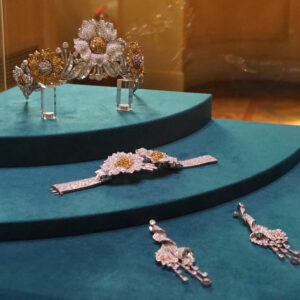
    • A platinum tiara fixed with over 2.000 diamonds and white pearls belonging to Princess Shivakiar, wife of King Fuad I.
A tiara of Princess Shivakiar - Royal Jewelry Museum - Egypt Vacation Tours
A tiara of Princess Shivakiar
    • A platinum crown of Queen Farida, the wife of King Farouk, is inlaid with white and yellow diamonds.
The crown of Queen Farida - Royal Jewelry Museum - Egypt Vacation Tours
The crown of Queen Farida
  • A brooch of princess Fawzia, the daughter of Fouad I and sister of King Farouk, from diamonds and gold.

Mohamed Ali family built a lot of palaces in Egypt:

  • Some of it used as the headquarters of rule as Al Gawhara Palace in Citadel of Saladin, Abdeen Palace, and Ras Al-Teen Palace.
  • Some were used for housing for the family members as Muhammad Ali Palace in Manial and Montazah Palace.

Al Minya City – Upper Egypt

Al Minya is one of the most important governorates of the upper of Egypt as its location between northern and southern Egypt. As well, it houses many historical sites and destinations dating back to different historical times.

During the ancient Egyptian history This city was once one of the great capitals of ancient Egypt. Also, it houses three of the most famous historical sites in Egypt. These sites are Beni Hassan, Tell El-Amarna, and Tuna El-Gebel.

  • Beni Hassan was a necropolis during the middle kingdom in ancient Egyptian civilization, as local rulers and military ‎leaders built their tombs there. It houses approx. 39 carved tombs in a limestone hill. These tombs reflect the power of the high officials at that time.
  • Tell El-Amarna: It is also called Akhetaten. It was the capital of ancient Egypt during king Akhenaten or Amenhotep IV period in the eighteenth dynasty, the New Kingdom. Also, it was the center for worshipping the god Aten.
  • Tuna El-Gebel was a necropolis during the Greco-Roman period. The ancient Egyptians considered it the center of worshiping the god Thoth or Djhuty, the god of wisdom and knowledge in ancient Egyptian civilization.

The significance of Al Minya during the Coptic period It was one of the stages of the Holy Family during their holy journey in Egypt.

The significance of Al Minya during the Islamic period Al Minya is proud that a number of companions of the Prophet Muhammad’s (peace be upon him) visited it and were buried there, as Khaled Ibn El Walid. As well, it was the home of one of the Prophet Muhammad’s (peace be upon him) wives, who Marya the Copt.

Museums of Al Minya city

  • Mallawi Museum: It opened for the first time on July 23, 1962, but it was closed after being vandalized in August 2013. Then it reopened in September 2016 after restoration for the building and collections. The museum displays the history of Al Minya through different historical periods.
  • Akhenaton Museum: when the Akhenaton Museum will be opened, it will be the largest in Upper Egypt. The concept of this museum will expose the religious thought of King Akhenaten and the reunification period.
Akhenaton Museum - Egypt Vacation Tours
Akhenaton Museum

The Royal Carriages Museum

Among the events of the Ministry of Tourism and Antiquities for opening new museums in Egypt, the Ministry opened three museums in one day, on October 31, 2020. These museums are The Royal Carriages Museum, Kafr El-Sheikh Museum, and Sharm El Sheikh Museum. The Royal Carriages Museum is located in Boulaq.

This museum is one of the most important four museums in the whole world, as there are just three museums with the same concept in Russia, England, and Austria.

This museum is considered a unique museum, as it distinguishes itself with its collections and building that reflect the authenticity of the Muhammad Ali family.

The history of the royal carriages museum: Khedive Ismail was the first one thought to construct this building for housing the royal carriages and horses.

At the first, this building was named (the Khedivial Carriages Service), but later, in 1922, during king Fouad’s reign, this name was changed to be (Royal Stables Department (Royal Mews)).

Like other royal buildings that belong to the Muhammad Ali family period, this building became owned by the Egyptian government after the revolution of 1952 and was converted into a museum in 1978.

The museum collections: The museum contains unique collections, all of them dating back to the Muhammad Ali family period. These collections are royal carriages of various sizes and types, as this museum is characterized by housing around 78 historically valuable royal carriages, among them the grand Alay Carriage.

This grand Alay Carriage was a gift given to Khedive Ismail during the occasion of the Suez Canal inauguration in 1869 by the wife of Emperor Napoleon III, Empress Eugenie. In return, Khedive Ismail gave her a golden bedroom. This carriage was used by Khedive Ismail during his wedding ceremony. King Farouk ordered to restore it and reused it on the inauguration of the Parliament in 1942.

As well, the museum houses oil paintings, several designs of uniforms of the Carriages Service employees, and horse riding equipment.

Some masterpieces in the museum

  • The Tonneau Carriage was used for driving his highness Prince Farouk, Prince of Upper Egypt, from 1922 to 1936.
  • Oil painting for king Fouad’s favorite donkey with a royal palace in the background.
  • The Caravan was used for transferring the big things like furniture.

Aswan City – History & Destinations

Aswan is one of the Egyptian cities in the upper of Egypt. It is located in the north of Nasser Lake. Aswan city distinguishes with its natural beauty, as it has the most beautiful views of the Nile River in Egypt ever. In addition, it houses unparalleled monuments dating back to several historical times as ancient Egyptian history, the Greco-Roman period, the Christian period, the Islamic period, and modern history. So it is considered an attractive tourist destination in Egypt.

Aswan city consist of 5 islands are Philea or Elephantine, Seheil, Agilkia, Bigeh, Kitchener’s islands.

The meaning of Aswan: Aswan is derived from the ancient word swan, meaning the market, as this city is located in an important commercial site linking Egypt and the southern lands.

The history of Aswan city: During ancient Egyptian history, Aswan houses several quarries for different types of rocks as granite, sandstone, and quartzite. These quarries were used by the ancient Egyptians to establish their temples and buildings. Also, it was the starting point of the military and commercial campaigns to the south to African countries.

During ancient times, Aswan was the center for many gods of ancient Egyptian beliefs, as the god Khnum, the god of the source of the Nile, and the goddess Isis.

One of the great historical events occurring in Aswan was the project of UNESCO for saving the Nubian monuments after the building of the High Dam.

The monuments of Aswan:

    Aswan contains monuments dating back to several historical times, as:

  • The monuments dating back to ancient Egyptian history are the Unfinished Obelisk and Abu Simbel Temples
  • The monuments dating back to the Greco-Roman period are Philae Temple, Kom Ombo Temple, and Temple Of Edfu
  • The monuments dating back to modern history are the High Dam, Nasser Lake, Mausoleum of the Aga Khan, the Nubian Museum, Botanical Garden, and The Nubian Village.

The Best Tour Company for Egypt

In this article, Egypt Vacation Tours team selected the best tour companies allowing you to make your trip to Egypt more successful, enjoyable, and offer you the best experience ever.

You believe that it is easy to visit Egypt and plan your itinerary alone, but once when you arrive, you will realize that it was better to book with a specialized travel agency.

Egypt is a so vast country and has several tourist destinations, so it is not easy to be visited alone. You will definitely need to tour guide or representative at least, and this will be arranged with a tour company. The tour guide or representative will provide you more experience during your visit to Egypt, more enjoyment, and more luxury.

These are the best tour companies will offer to you more valuable tour in Egypt:

1 – Friendly Planet Travel Friendly Planet Travel offers you a reasonably priced, comfortable, and small-group tour to Egypt. As well, it has its own specialist tour guides.

It is good to mention that Friendly Planet Travel making International flights and King Tut Tomb in the valley of Kings included in your trip.

2 – Intrepid Intrepid travel distinguishes offering a variety of prices. With Intrepid travel, you will enjoy having a new experience, as you will travel from Cairo to Aswan via overnight sleeper train.

3 – Overseas Adventure Travel Overseas Adventure Travel has a great history in arranging tours to Egypt and distinguishes with its good guides. They make Abu Simbel temple tour included in your itinerary. It is good to mention that Overseas Adventure Travel team offers its Nile cruise tours on Dahabya Nile Cruise.

4 – Memphis Tours Memphis Tours, as Overseas Adventure Travel, has a great history in arranging tours to Egypt. They offer basic tours at affordable prices and cover the most of major attractions of Egypt.

5 – Explore Egypt Tours Explore Egypt Tours is one of the most famous travel agencies in Egypt, as it is one of the first companies in Egypt arranging tours to the Grand Egyptian Museum (the GEM), as was mentioned by CNN.

6 – Egypt Vacation Tours Egypt Vacation Tours is one of the most active travel agencies in Egypt, as they are famous for arranging tours to new destinations in Egypt like the Grand Egyptian Museum (the GEM). In addition, they are specialized in offering special permits tours.

The Ramesseum of King Ramesses II

The Ramesseum is located on the west bank of the Nile River in Luxor city. Although the rest of the temple is considered remains, it is one of the most important destinations for lovers of King Ramesses II. This temple is dedicated to King Ramesses II as his funerary temple and the god Amun-Ra.

The Ramesseum plan: Unlike the other well-preserved structures of King Ramesses II in other temples as Karnak Complex and Luxor temple, most of his funerary temple, the Ramesseum temple, is in ruins today.

  • Like other temples in ancient Egypt, the entrance of this temple began with the pylon, but it was collapsed. This pylon was decorated with the inscription for the Kadesh battle.
  • Then there is the first open courtyard that has nothing remains but a colonnaded hall. This hall houses the remains of a colossal statue to King Ramesses II. This statue has an exciting story, which we will tell you later.
  • Then the great hypostyle hall, there are 29 columns that are still standing.
  • Then the second courtyard. It is in better condition, as you will be able to recognize two rows of statues for king Ramesses II representing him in Osiris form.
  • Then there is the second hypostyle hall. It contains 8 columns in the form of papyrus. This hall distinguishes with a special inscription that represents astronomical scenes.

Also, there are depictions of giving offerings to several gods and the sacred boat of Amon Ra. In addition, a unique scene, as king Ramesses II appears sitting in front of the god Thoth and the goddess Seshat and they are writing his name on the leaves of the tree of life to wish him a long life.

In addition, there is a scene for king Ramesses II sitting in front of the Triad of Thebes. Below this scene, there is a depiction for the sons of the king.

King Ramesses II in front of the Triad of Thebes - The Ramesseum - Egypt Vacation Tours
King Ramesses II in front of the Triad of Thebes
  • Finally, at the end of the temple, there are many rooms. Among these rooms, there are the library, the storerooms of the temple, and the sanctuary or the holy of holies, that is dedicated to the god Amun-Ra and King Ramesses II.

The names of the Ramesseum:

  • The first name was given to this temple was during the Greek period when they linked between the northern statue of king Amenhotep III and their hero Memnon, They considered the Ramesseum as Memnonium or the tomb of Memnon.
  • Nowadays, the temple is known by the name of Ramesseum that is given to the temple by Champollion, who deciphered hieroglyphics through the Rosetta stone.

There is a legend linked with the remains of the fallen colossal statue of King Ramesses II, which in the first open courtyard, as classical visitors called it Ozymandias. These fallen remains inspired the English poet Percy Bysshe Shelley to write a poem and linked in it between the statue and their hero Ozymandias.

Ozymandias Statue - the Ramesseum - Egypt Vacation Tours
Ozymandias Statue

Deir El Medina – the Valley of Workers

Deir El Medina is one of the most famous sightseeing on the west bank of Luxor city, as it is a city for the locals located inside a royal site. Here, you will see another kind of tombs; they are not royal tombs but belong to ordinary citizens who built the royal tombs.

The history of Deir el-Medina Bernard Bruyère discovered this site in the 90s, after the discovery of Howard Carter to the tomb of Tutankhamun, Bernard Bruyère considered this is a unique discovery, as there were many of ostraca are discovered on this site. These ostraca documented the lifestyle and community of ancient Egypt meticulously, as they refer to the Women’s lifestyle, the Law, and the medical care in this community.

This place was the village where the ancient Egyptian workers and artisans of the 18th, 19th, and 20th dynasties of the New Kingdom were lived. Those workers and artisans worked in the Valley of Kings and the Valley of Queens, as they carved the tombs, which dazzle the whole world, in the mountain and decorated them.

Perhaps, the Egyptian authorities ordered to establish this city apart to keep what was happening inside the Valley of Kings and the Valley of Queens secret for avoiding being stolen.

It is believed that the first usage of Deir el-Medina was during King Thutmose I reign, while it was abandoned during the Ramesside Period.

The city housed approx. 70 families and sixty-eight houses varying in their size. The style of these houses was the same, as the walls were made of mud brick. Houses consisted of four to five rooms, comprising an entrance, main room, two smaller rooms, kitchen with cellar, and staircase leading to the roof.

Deir El Medina - Egypt Vacation Tours 1
Deir El Medina

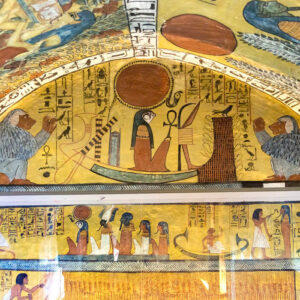
Also, this place contains the tombs of those workmen. These tombs appear in one room decorated with reliefs depicting the owner of this tomb with his family and during his journey to the other world.  You can imagine how amazing the decorations of these tombs are, as it was ornamented by the artisans who decorated the wonderful tombs in Valley of the Kings. For example, these tombs are Inerkhau and Sennedjem tombs.

Sennedjem Tomb - Deir El Medina - Egypt Vacation Tours
Sennedjem Tomb – Deir El Medina

The names of Deir el-Medina The ancient Egyptian name of this site was (Set maat), which means the place of truth. Also, the habitants were named servants in the place of truth. Deir el-Medina, the most famous name for this site now, is an Arabic word meaning the monastery of the city, as there was a temple for goddess Hathor beside the city. This temple was built during the Ptolemaic period, but it is changed to be a Christian monastery.